
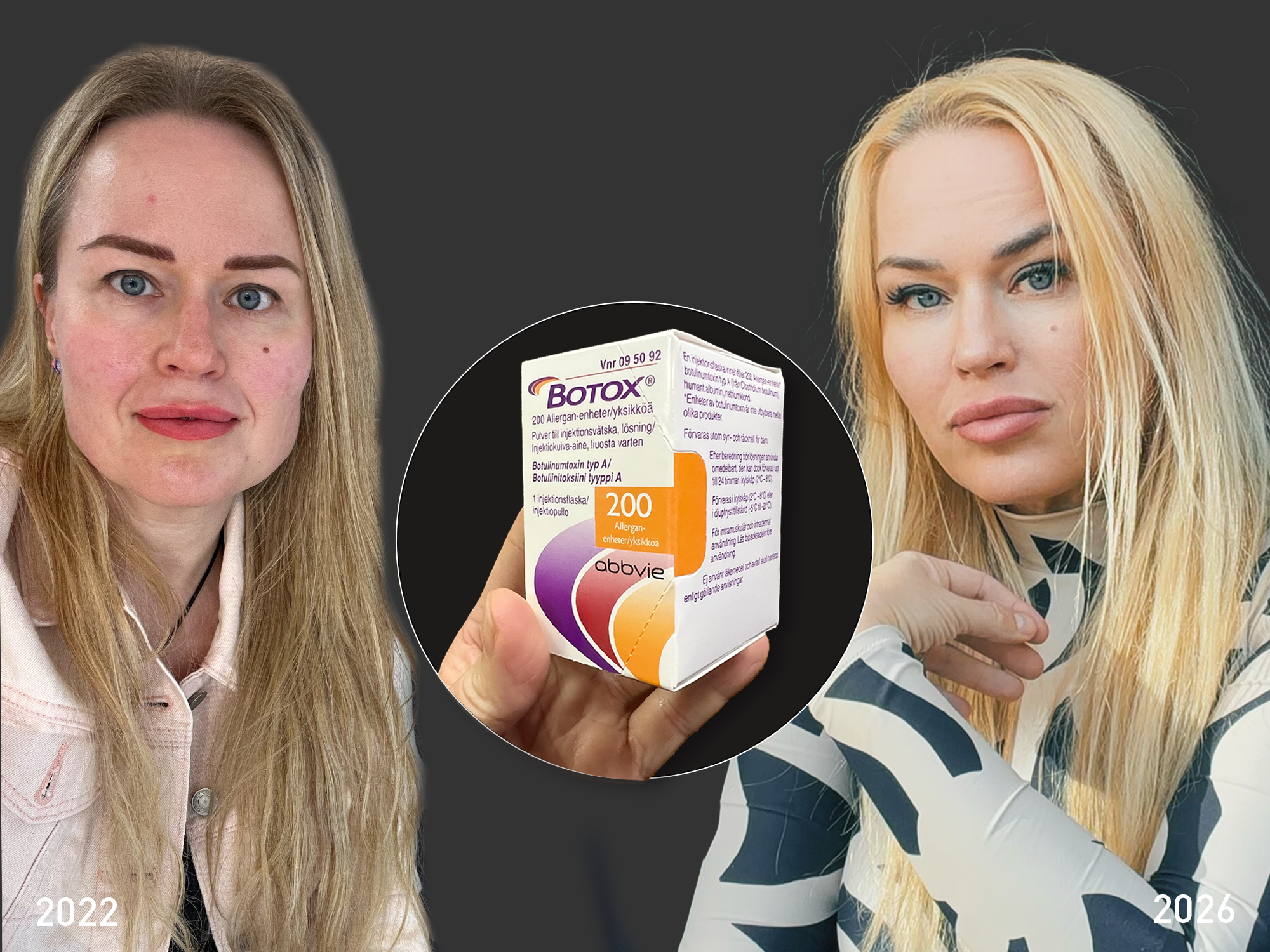
I had been seeing the same aesthetic nurse for quite some time.
We had tried HIFU, lip fillers, PDO threads, fat-dissolving lipolysis and more.
I always told her which parts of my face I wanted to improve and how.
Once, as I was going through my wish list again, she looked thoughtful and said,
“It’s not the signs of aging. It’s how you use your facial muscles.”
That nurse didn’t do toxin treatments herself, but this was the moment I started to understand how much the facial muscles affect the way we look.
When certain facial muscles are too strong, they pull the expression down and create lines that make the face look more tired.
Overdeveloped muscles can also make the face too wide, which bothered me too.
Botulinum toxin helps by gradually weakening parts of these muscles. Wrinkles smooth out and the treated muscles get smaller.
In skilled hands, the balance of the facial muscles can be fine-tuned quite precisely.
Botulinum toxin has a bad reputation, at least if you believe the scandal headlines of years past.
Whenever a Hollywood star’s cosmetic work went wrong, the tabloids screamed that Botox had ruined their face.
Those images have stuck. Many people still fear that toxin treatments will leave their face puffy and frozen.
Toxin treatments can go wrong too, of course, but in many of those headlines the problem seemed to lie elsewhere.
Most of the time, the faces looked like the result of overdone fillers.
Despite the prejudice, botulinum toxin has been described as the world’s most popular non-surgical aesthetic procedure right now, for both women and men.
According to a recent report by the International Society of Aesthetic Plastic Surgery (ISAPS), plastic surgeons alone performed around 7.3 million botulinum toxin treatments in 2025.
Almost half of these were for people aged 35 to 50.
The treatment is effective, and people are generally happy with it.
Botox is a registered trademark of the pharmaceutical company AbbVie.
Other drug makers’ equivalents include Dysport, Xeomin, Azzalure and Bocouture. All of them are based on botulinum toxin type A, a neurotoxin produced by the bacterium Clostridium botulinum.
“Neurotoxin” sounds alarming, but it helps to remember that this is a tightly regulated medicine.
In Finland, the injections may only be given by doctors and dentists, or by nurses with the right training and skills working under a doctor’s supervision.
The doses used in cosmetic and medical treatments are fractions of a microgram.
The toxin is used locally and in very small amounts.
In medicine, botulinum toxin is used to ease painful or troublesome conditions such as migraine and excessive sweating.
Everyone uses their facial muscles in their own way. Some muscles get more use, others less.
These habits are largely unconscious and involuntary.
No amount of face yoga can relax and retrain the facial muscles the way botulinum toxin does, partly or fully switching off a muscle’s activity for a limited time.
When the sun hits your eyes, for example, you frown without thinking. As far as I know, no yoga exercise can stop that, whereas a toxin treatment keeps the forehead relaxed even then.
That said, if some muscles have been too dominant and others too weak, it’s worth practicing how to activate and relax them.
Botulinum toxin is a great support for that kind of retraining.
Before my first toxin treatment, I tried a face yoga method that was being hyped worldwide as the miracle alternative to Botox and other aesthetic procedures.
The promise turned out to be overblown nonsense.
There’s a lot of hype around face yoga and facial exercise, kept alive in their own social media groups.
I watched a Facebook group with hundreds of thousands of members declare its own method the only right answer, even when it hadn’t helped the people asking.
Comments that took a wider view were moderated away. Suggesting, for example, that a particular problem could actually be solved with botulinum toxin rather than face yoga got the comment deleted and earned a warning.
It was heartbreaking to see some members sink into despair because, despite all their practice, they couldn’t reach their goals. They had believed the marketer’s unrealistic promises.
I consider it unethical to market results that simply can’t be achieved.
People waste time, money and energy and keep looking for faults in themselves when the results they hope for never come.
At worst, facial exercises and face yoga can even make the original problem worse.
I’ve had to have botulinum toxin myself to undo the effects of overenthusiastic facial exercise, after the targeted muscles grew too strong and caused unwanted lines.
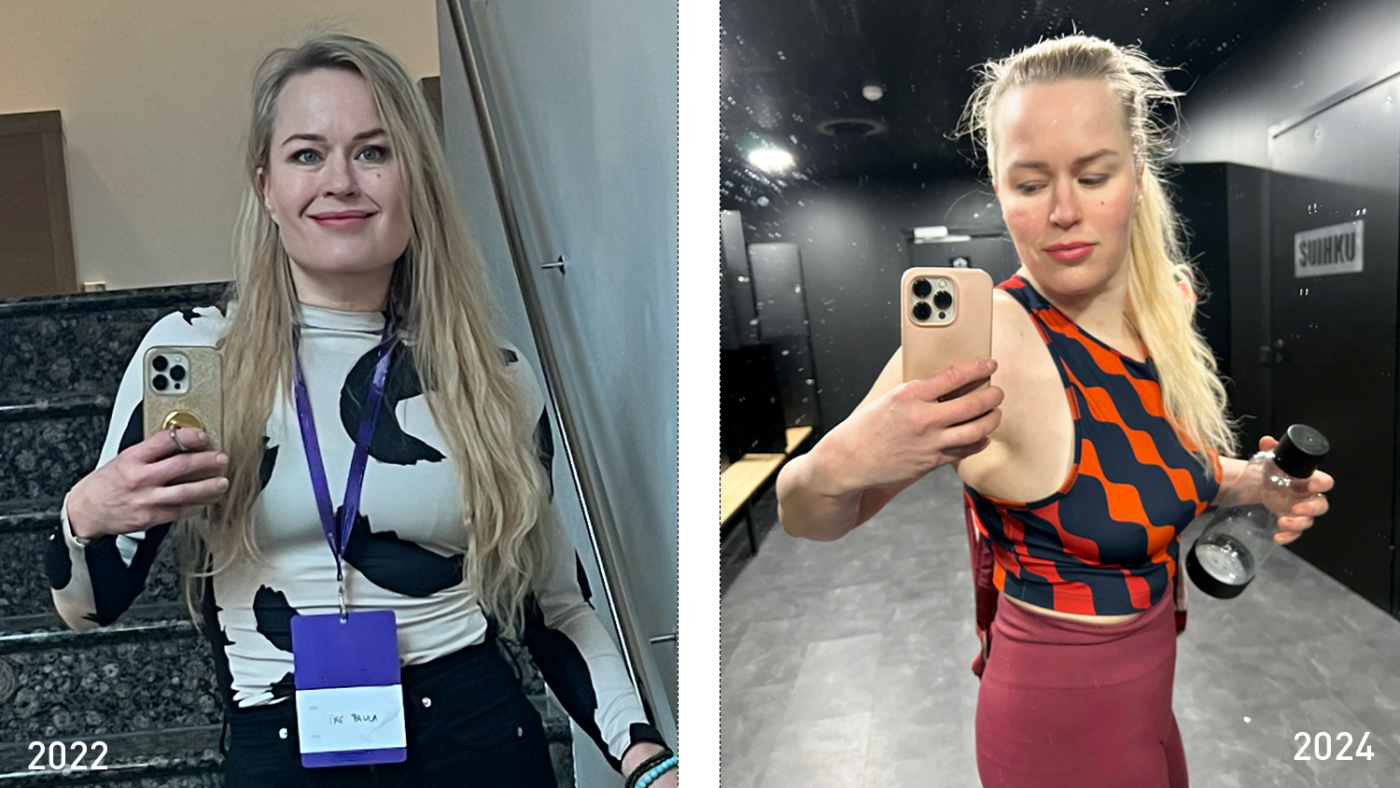
Some people wrinkle their nose, others don’t. Practically everyone uses their forehead and the muscles around the eyes, but the way we use our facial muscles is individual.
I naturally tend to pull down the corners of my mouth, which makes me look tired and angry.
I first tried aesthetic botulinum toxin in the summer of 2022.
The treatment targeted the depressor anguli oris (DAO) muscles, which pull the corners of the mouth down.
It took a few days for the toxin to kick in.
For the first few days after the treatment, I had a headache.
It was probably because I was unconsciously trying to use muscles that were very strong in my face.
This side effect is common after a first treatment, and it went away on its own.
My angry look softened, and to my surprise my face ached a lot less.
When it was time to repeat the Botox treatment after about three months, I gave the nurse free rein.
This time she also put a few injections into my forehead and around my eyes.
My expression became much more relaxed, and I noticed I had less tension in my facial muscles.
Later, I went to a dentist for help with bruxism, or teeth grinding.
By then it was affecting my life so much that I woke up with sore cheeks and was getting through a lot of painkillers.
A night guard stops the teeth from breaking, but it didn’t stop the grinding.
Botulinum toxin did. With treatments every three months, I got rid of pain I’d had for as long as I could remember.
At different appointments, we looked at the different muscles causing the pain, and a lot of toxin was used. It worked.
Before the treatments, my face had always been wide, whatever my weight.
My strong facial muscles had probably developed partly through stress, but also as a side effect of tensing my face during gym workouts.
I had what’s known as a weightlifter’s face.
I had assumed the width of my face was fat, but with botulinum toxin, the masseter muscle that widens the face, for example, melted away to nothing.
For the first time in my life, I had a really narrow face, even though I put on a little weight during the year-long treatment period.
After the dentist’s treatments, my face was perhaps even too narrow from a beauty point of view.
The treatment had targeted the symptom, not my appearance.
When I next started testing full-face botulinum toxin treatments with an aesthetic nurse, she first had me wait six months for my facial muscles to get stronger again.
Botulinum toxin is at its strongest a couple of weeks after the injections, and then the muscle gradually recovers. Treatments should be at least three months apart, but longer breaks can also make sense if the muscles have shrunk too much.
The nurse’s full-face treatments focused on the beauty of my face as a whole, in three dimensions.
It wasn’t about fixing one spot but about the overall expression.
Natural-looking results where the face doesn’t freeze are this nurse’s signature. People who didn’t know often told me I was unbelievably beautiful naturally, which I found amusing.
These treatments always included a free follow-up two weeks later, when she topped up the treatment if needed.
That’s how I got an aesthetically optimized result.
The more I saw the same nurse, the better she got to know my face and how it responds. The results have improved over the years.
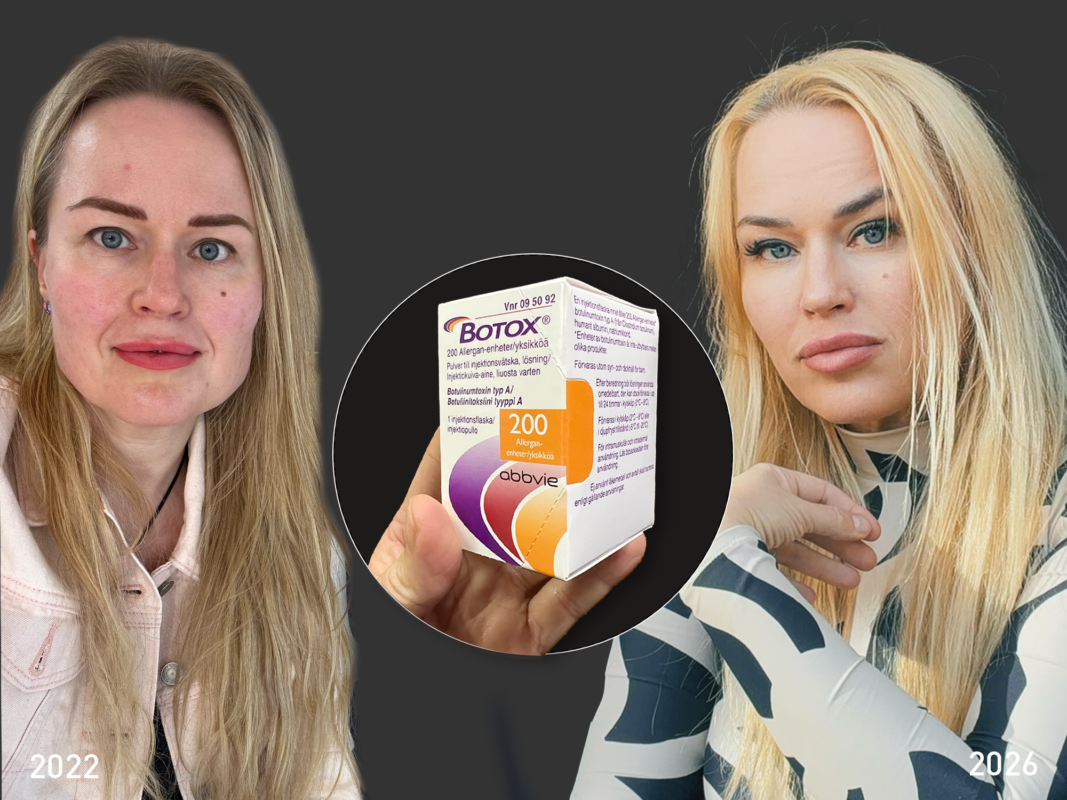
You can clearly see what the aesthetic treatments have done to my face in photos taken four years apart.
My expression has changed, as the photo shows. The muscles that used to be very strong haven’t gone back to how they were.
I’ve started to forget how to frown. I also no longer tense the large platysma muscle in my neck the way I used to.
Face yoga and facial exercise do play a part, in the sense that I now pay attention to which facial muscles I activate during gym exercises.
During a movement, it’s worth engaging the muscles that turn the corners of the mouth up and keeping the neck and forehead muscles as relaxed as possible.
Sometimes I also wear face tape at night to stop certain muscles from activating involuntarily.
—
In an upcoming article, I’ll take a closer look at the treatment areas for aesthetic botulinum toxin, so stay tuned!
You can send me requests for that story on Instagram @toimittajatestasi, for example.
Sundaram, H. et al. Global Aesthetics Consensus: Botulinum Toxin Type A – Evidence-Based Review, Emerging Concepts, and Consensus Recommendations for Aesthetic Use, Including Updates on Complications. Plastic and Reconstructive Surgery 2016.
https://pubmed.ncbi.nlm.nih.gov/26910696/
International Society of Aesthetic Plastic Surgery (ISAPS). ISAPS International Survey on Aesthetic/Cosmetic Procedures Performed in 2025.
https://www.isaps.org/media/ua4leneo/isaps-global-survey_2025.pdf
Jalali, A. et al. Full-face aesthetic treatment with onabotulinumtoxin A: Results from a retrospective real world analysis. JPRAS Open 2025.
https://pubmed.ncbi.nlm.nih.gov/41450448/
Sundaram, H. et al. Global Aesthetics Consensus: Hyaluronic Acid Fillers and Botulinum Toxin Type A – Recommendations for Combined Treatment and Optimizing Outcomes in Diverse Patient Populations. Plastic and Reconstructive Surgery 2016.
https://pubmed.ncbi.nlm.nih.gov/27119917/
Seraj, S. S. et al. Efficacy of Conservative Techniques for Mechanical Facial Rejuvenation: A Systematic Review. Aesthetic Surgery Journal Open Forum 2025.
https://pubmed.ncbi.nlm.nih.gov/41322034/
Ferrillo, M. et al. The Role of Botulinum Toxin for Masseter Muscle Hypertrophy: A Comprehensive Review. Toxins 2025.
https://www.ncbi.nlm.nih.gov/pmc/articles/PMC11860558/
We use cookies to run the site, for visitor analytics and for social media content. Privacy Cookie policy

